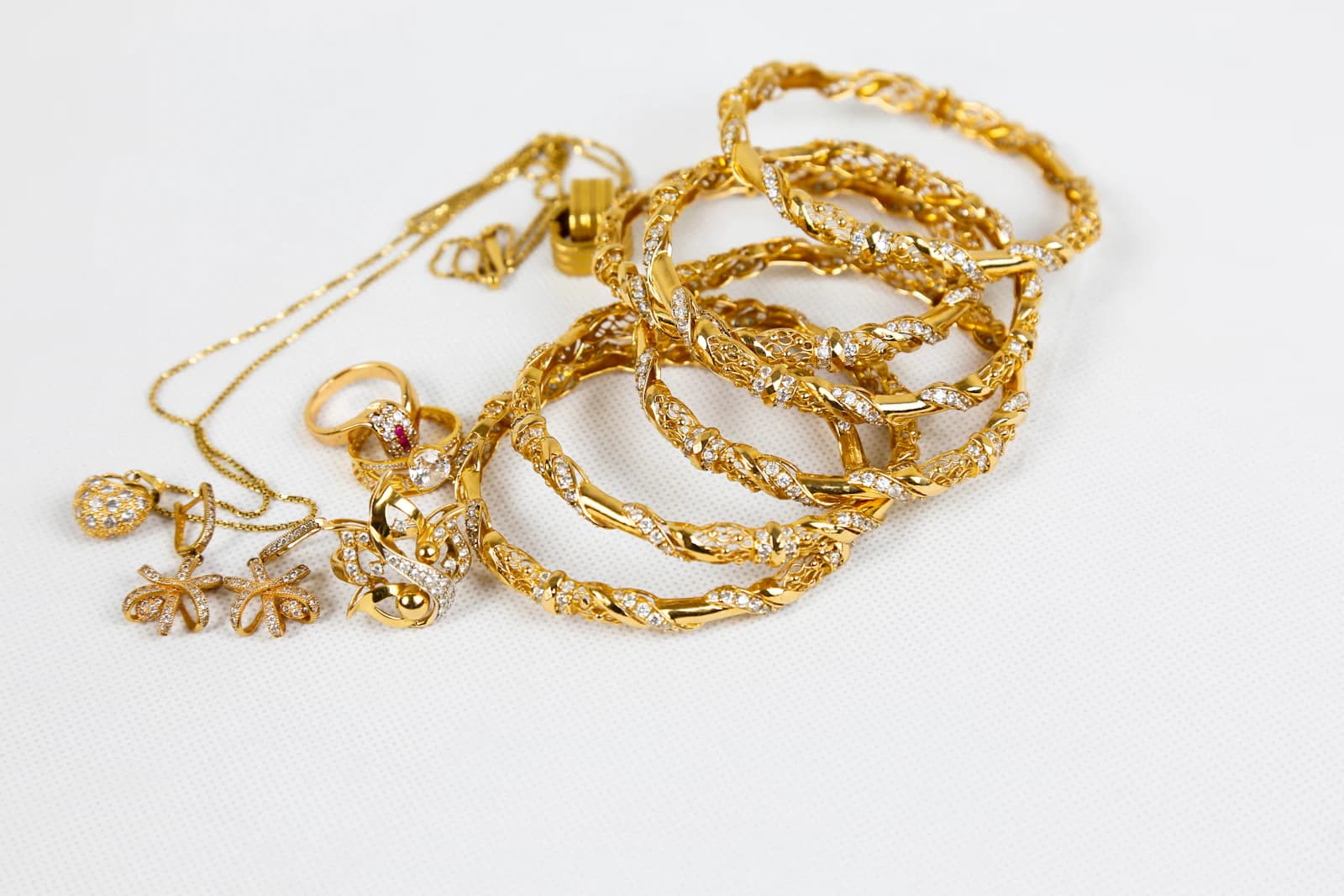
Karat is a percentage, not a quality grade
The karat system divides gold purity into 24 parts. 24-karat gold is pure gold — all 24 parts out of 24. 18k is 18 parts gold and 6 parts other metals, which works out to 75% pure. 14k is 58.3% gold. 10k, the legal minimum to be sold as "gold" in the United States, is 41.7%.
So a 14k chain isn't a "lower quality" 24k chain — it's a chain that contains a little over half its weight in pure gold, with the balance made up of metals like copper, silver, nickel, and zinc. Those other metals aren't filler for filler's sake: pure gold is soft enough to scratch with a fingernail, so alloying it makes jewelry hard enough to survive daily wear. That's why 14k is the everyday standard in American jewelry — it keeps most of the gold while wearing like armor compared to 24k.
How to read the stamps
Flip your jewelry over and look for tiny stamped markings — inside the band of a ring, on the clasp of a chain, on the post of an earring. American pieces are usually marked in karats: 10k, 14k, 18k. European pieces are usually marked in fineness, which is purity out of 1,000: 417 means 10k, 585 means 14k, 750 means 18k, and 999 means pure.
One important warning: a stamp is a claim, not a guarantee. Counterfeit stamps exist, and worn plating can fool the eye. That's why any serious buyer — including us — tests the metal itself, with acid test kits or electronic testers, rather than taking the stamp's word for it. It costs you nothing to have it tested at our counter, and you'll know for certain in minutes.
Solid, filled, and plated are very different animals
"Gold-plated" (GP), "gold electroplate" (GEP), and "heavy gold electroplate" (HGE) pieces carry a microscopically thin layer of gold over base metal — usually far less than 1% gold by weight. "Gold-filled" (GF) is a thicker bonded layer, but still typically only about 5% gold. "Vermeil" is gold plating over sterling silver.
For melt value, that distinction is everything: a solid 14k bracelet might be worth hundreds, while an identical-looking plated bracelet is worth close to nothing as metal. The stamps above usually tell the story — GF, GP, HGE, or fractions like "1/20 12k GF" mean plated or filled. When in doubt, bring it in; testing tells the truth in seconds.
What karat means for your cash offer
Gold's value formula is refreshingly simple: weight × purity × the current market ("spot") price of gold. A 20-gram 14k chain contains about 11.7 grams of pure gold; that number times today's spot price is the metal's intrinsic value, and offers are calculated from there.
Two practical takeaways. First, condition doesn't matter for melt value — a snapped chain, a single earring, or a ring missing its stone contains exactly as much gold as it did intact, which is why we happily pay on broken jewelry every day. Second, karat is not the whole story for intact pieces: name-brand, antique, or finely made jewelry can be worth more as jewelry than as metal, and an honest appraisal accounts for both. Bring it in and we'll tell you which side of that line your piece sits on — the estimate is free.
Bring it in — estimates are free
Reading gets you close; the scale and the tester get you exact. Free, fast, no obligation — since 1955.